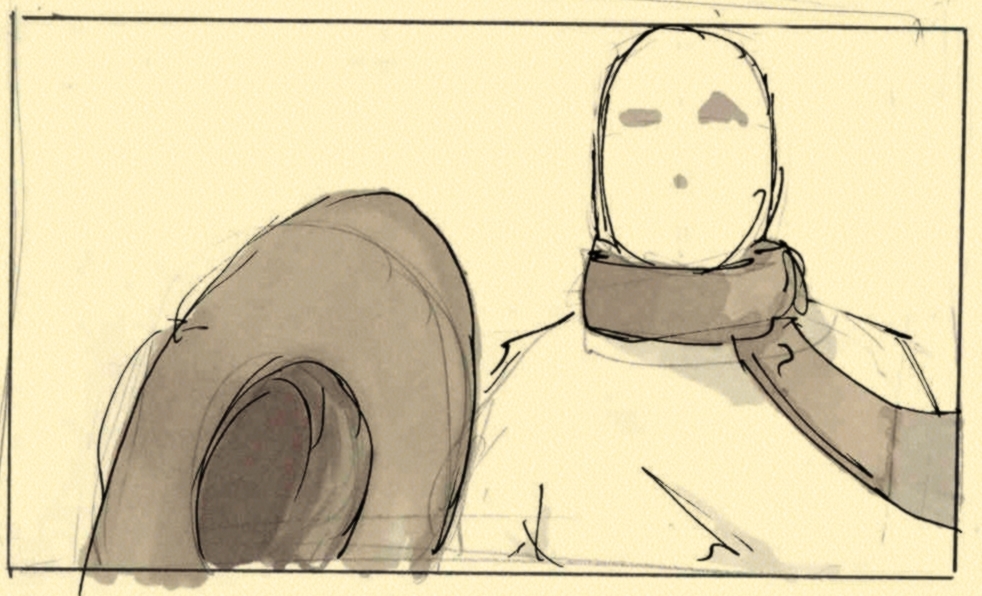
After reboarding the sequence I digitized the drawings and polished them off and shaded them in photoshop and coral painting. Below is much of the rendered storyboard and some raw templates for the crude animating. The animatic itself was created using Adobe After Effects, of which I took part in the three day course to better understand the program. Whilst the animating itself remains entirely crude, fluidity in animating was never my objective here, but rather simply to demonstrate pace and body language via my Principles of Storyboarding.
Saturday, 14 May 2011
Development of the Buskers
My first love always always comes from life drawing, and gestural sketches. Because of my interest to reaffirm my understanding of body language, and to better aid this side-project, I chose to sign up to a local life drawing course at Telford college during the week nights. Whilst most of the work there better suited Illustrative styles and observations, some offered a great chance to flex my gestural muscles that could relate to this project. Below are but a few of the relative sketches and larger studies into multiple poses, form and stance with 30 second studies.
15 second sketches with black marker. Studies in the line of action as well as economy of line.


As a source of reference, particularly for the scarf element to my storyboard, I became intrigued by the art of ribbon dancing, in particular how the pose and movements of the dancer were enhanced by the reactions of the ribbon, creating shapes that complimented the overall gesture.Below are a few of my inspired illustrations and poses relating to the scarf/ribbon dance sequence.
Original board passes, sequencing dance flow and movement towards frame.
Body language
Despite the commissions I was and am still attached with, I felt the need to personally address an area of drawing I wanted to brush up upon. Body language! Something vital to storyboarding is the ability to communicate through the use of body gestures where sound and dialogue is absent. Because of this I wanted to create a mini project to work on the side that would strengthen this aspect of drawing for me.
In the previous year during the 'narrative' module, I developed a basic outline for a story inspired by the duelling banjo sequence from the film 'Deliverance'. Below was the original thumbnails and storyboard I created.


Ultimately I became inspired by a beautiful piece of animation from artist Michael Dudok De Wit called 'The Monk and the Fish'- A story of an infuriated Monk trying to catch the ever elusive fish. The entire story is expressed through the use of music, and how the body language throughout denotes the change in emotion and tension. It was of this that inspired me to attempt something similar, to storyboard and develop a crude animatic through the use of music and body language, further providing an exercise to prove certain aspects of my developed Principles for storyboarding.
A further influence is the Pixar short 'One Man Band' that centers around a similar theme.
The Incredible thing about The Incredibles
To kick things off I thought I'd showcase one of the entertaining instalments of Pixar animation studio's series of films The Incredibles, directed by Pixar veteran Brad Bird.

All praise aside to the storytelling and special effects from the bigwigs behind Pixar, there is something in particular that I wanted to focus upon- the Animatic.
An animatic, for those who remain in the dark, is essentially a mock up video of the storyboard edited together with sound to crudely show the pacing of a particular sequence in any given film, which is especially useful and perhaps essential in animation productions. It also highlights in advance any potential flaws in the visual storytelling that can quickly be altered before any principal photography or production itself kicks in!
Take a peak at one of the animatic sequences prepped for the character 'Dash's sprint against ze bad guys:
If you're wondering how they made it, it seems like a simple case of scanning in the original drawings from the 'beat' boards/storyboards and then using Photoshop to polish and adjust, then into Adobe After Effects, or some In-house variation of that programme, to move the images around for fluidity and animation, and of course- if you spotted them- the computer generated models of the flying blade thingamajigs- no doubt in Maya or, again, another In-house variant. I should stress that the level of quality in that animatic is insane, and by no means would other film reels look nearly as polished. We are talking about Pixar here, after all.
Details of these programmes can be browsed here if you want to give them a shot, though they will burn a hole in your pocket to get them. There are, so I hear, other means of obtaining them however. *whistles*
After Effects: http://www.adobe.com/products/aftereffects/
In regards to the CG programme, Pixar studios claim they use their own built software, derived from Maya, called 'Marionette'. And there is as much known of it as there is about the queen's personal video game collection. Top secret stuff, y'see.
I found a nice little article that reveals some of the thinking behind the animatics created forThe Incredibles, and how Director Brad Bird insisted on drawing as the sole form of communication across the board.

This details the, as of then, new desktop programme, which became a milestone in Pre-production advances, made just to cater to Brad's visual method of communication by scribbling all over people's works. This enabled him to make annotations digitally on the designer's screens, similar to the above image, without wasting time and effort obtaining hard copies of the illustrations, or disconnecting his ideas from the digital work in front of him. Apparently it's been used on every Pixar production since! No doubt this played a massive role in speeding up the design AND making sure everything was to the highest quality!
Subscribe to:
Posts (Atom)